

The Dawn of the Food Vending Machine: How Automated Restaurants Are Transforming the Way the World Eats
Introduction: A New Era in Food Retail
The global food industry is entering a new phase. Rising labor costs, changing consumer habits, and the demand for convenience are pushing businesses to rethink how meals are prepared and sold. In this context, the food vending machine is emerging as one of the most innovative solutions in modern food retail.
For decades, vending machines were associated mainly with snacks, sodas, and coffee. Today, however, technological advancements are transforming these automated systems into sophisticated platforms capable of delivering fresh, hot, and high-quality meals at any time of the day.
Welcome to the dawn of the food vending machine revolution.
In cities around the world, automated food systems are beginning to redefine the concept of restaurants. Consumers can now access hot meals, gourmet dishes, and ready-to-eat food 24 hours a day without the need for traditional kitchens, chefs, or waitstaff.
For entrepreneurs, property owners, and food service operators, this transformation opens up an entirely new market opportunity.
The rise of automated food solutions is not simply a trend. It represents a fundamental shift in the way food is produced, distributed, and consumed.
What Is a Food Vending Machine?
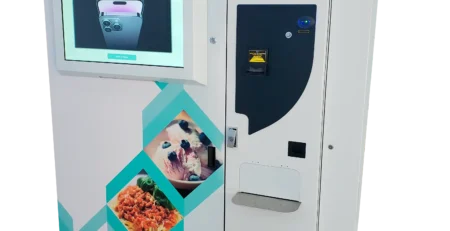
A food vending machine is an automated system designed to store, prepare, heat, and dispense food products without the need for direct human assistance.
Unlike traditional snack vending machines, modern food vending machines can handle a wide variety of products, including:
-
Fresh meals
-
Hot dishes
-
Refrigerated ready-to-eat food
-
Frozen meals
-
Gourmet products
-
Bakery items
-
Pasta dishes
-
Pizza
-
Rice bowls
-
Healthy meals
Thanks to advanced refrigeration, heating technologies, and digital interfaces, these machines can maintain high food safety standards while delivering restaurant-quality meals within minutes.
Modern machines are also equipped with:
-
smart inventory management
-
remote monitoring systems
-
touch-screen interfaces
-
cashless payment technologies
-
real-time data analytics
These features allow operators to manage entire networks of machines efficiently and profitably.
Why Food Vending Machines Are Growing Worldwide
The rapid growth of the food vending machine market is driven by several powerful global trends.
1. Rising Labor Costs
One of the biggest challenges facing the food service industry is the increasing cost of labor.
Restaurants must pay chefs, kitchen staff, waiters, cleaners, and managers. In many countries, labor can represent 30% to 40% of operating costs.
Food vending machines dramatically reduce these costs. A single automated unit can operate continuously without staff, allowing businesses to maintain profitability even in high-cost markets.
2. The Demand for 24/7 Food Availability
Modern consumers expect convenience.
People work irregular hours, travel frequently, and often need food outside traditional restaurant schedules. Late-night workers, hospital staff, students, and travelers all represent customers who require food at unusual times.
Food vending machines solve this problem perfectly.
They can operate 24 hours a day, 7 days a week, providing hot meals whenever customers need them.
3. Urbanization and Limited Space
Urban environments are becoming increasingly dense and expensive. Opening a traditional restaurant often requires large spaces, expensive renovations, and long bureaucratic procedures.
Food vending machines, on the other hand, require very little space.
Many modern systems occupy less than one square meter, allowing them to be installed in locations where a restaurant would be impossible.
Examples include:
-
train stations
-
airports
-
office buildings
-
hospitals
-
universities
-
shopping centers
-
factories
-
hotels
-
gyms
-
residential complexes
This flexibility makes vending machines an extremely attractive business model.
4. Technology Is Making Automation Better
Technology is the key driver behind the new generation of food vending machines.
Innovations in food preservation, heating systems, and digital interfaces have made it possible to deliver meals that are far superior to traditional vending machine products.
Modern machines can now:
-
heat meals evenly in seconds
-
maintain precise temperature control
-
monitor stock remotely
-
collect sales data in real time
-
accept multiple payment methods
This technological evolution is transforming vending machines into fully automated micro-restaurants.
The Dawn of the Automated Restaurant
The concept of the automated restaurant is rapidly gaining popularity.
In this model, food is prepared in centralized kitchens and then distributed through a network of vending machines located in strategic areas.
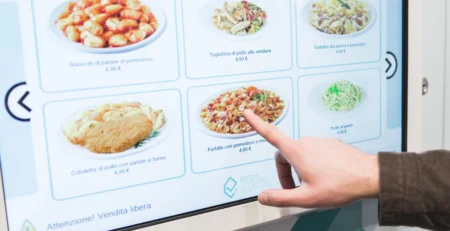
Customers simply select their meal on a touch screen, pay digitally, and receive their dish within seconds.
This system offers several advantages:
-
lower operating costs
-
faster service
-
consistent food quality
-
reduced waste
-
scalable distribution networks
As a result, many food entrepreneurs are beginning to view vending machines not just as devices, but as complete food distribution platforms.
How Entrepreneurs Make Money with Food Vending Machines
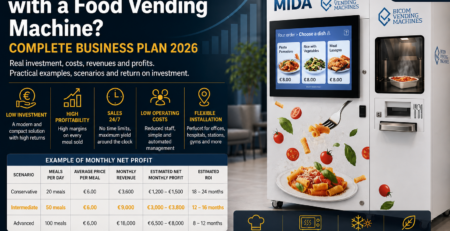
The food vending machine business model can be extremely profitable when implemented correctly.
Operators generate revenue by selling food products directly through the machines. Profit margins depend on several factors:
-
food cost
-
location quality
-
machine technology
-
product mix
-
pricing strategy
In many cases, the gross margin on food vending products ranges between 40% and 70%.
With the right location and product assortment, a single machine can generate significant monthly revenue.
Entrepreneurs often scale their operations by creating networks of machines across multiple locations.
The Importance of Location
As with many retail businesses, location is one of the most critical factors for success.
High-traffic environments offer the greatest potential for sales.
Some of the most profitable locations include:
-
hospitals
-
universities
-
office complexes
-
factories
-
transportation hubs
-
tourist areas
-
large residential buildings
These environments provide a constant flow of potential customers who appreciate quick and convenient meal options.
Food Vending Machines and the Rise of Smart Food Retail
Another major trend shaping the industry is the integration of vending machines with digital technologies.
Smart vending systems can now connect to cloud platforms that allow operators to monitor and control their machines remotely.
This includes:
-
real-time sales tracking
-
automatic stock alerts
-
remote pricing adjustments
-
predictive maintenance
-
consumer behavior analytics
These tools make the management of large vending networks far more efficient.
Why Food Vending Machines Represent a Massive Opportunity
The global vending industry is undergoing rapid transformation.
Traditional snack machines are gradually being replaced by more advanced systems capable of offering complete meals.
For investors and entrepreneurs, the opportunity is enormous.
The combination of automation, food service, and digital technology creates a scalable business model that can expand across cities, countries, and even continents.
Companies specializing in innovative food vending solutions, such as Bicom Vending, are helping drive this transformation by developing machines designed specifically for the modern food market.
The Role of Innovation in Food Vending
Innovation continues to push the boundaries of what vending machines can do.
Some of the most exciting developments include:
-
robotic cooking systems
-
smart packaging solutions
-
AI-driven demand forecasting
-
personalized menu suggestions
-
mobile app integration
These technologies will further enhance the capabilities of food vending machines, making them even more appealing to consumers and operators.
Conclusion: The Dawn of a New Food Economy
The food vending machine is no longer a simple snack dispenser. It has evolved into a powerful platform capable of reshaping the global food service industry.
As automation, technology, and consumer expectations continue to evolve, vending machines will play an increasingly important role in how meals are distributed and consumed.
We are witnessing the dawn of a new food economy, where automated systems deliver high-quality meals quickly, efficiently, and profitably.
For entrepreneurs, property owners, and food brands, embracing this technology today could mean securing a competitive advantage in the food retail landscape of tomorrow.