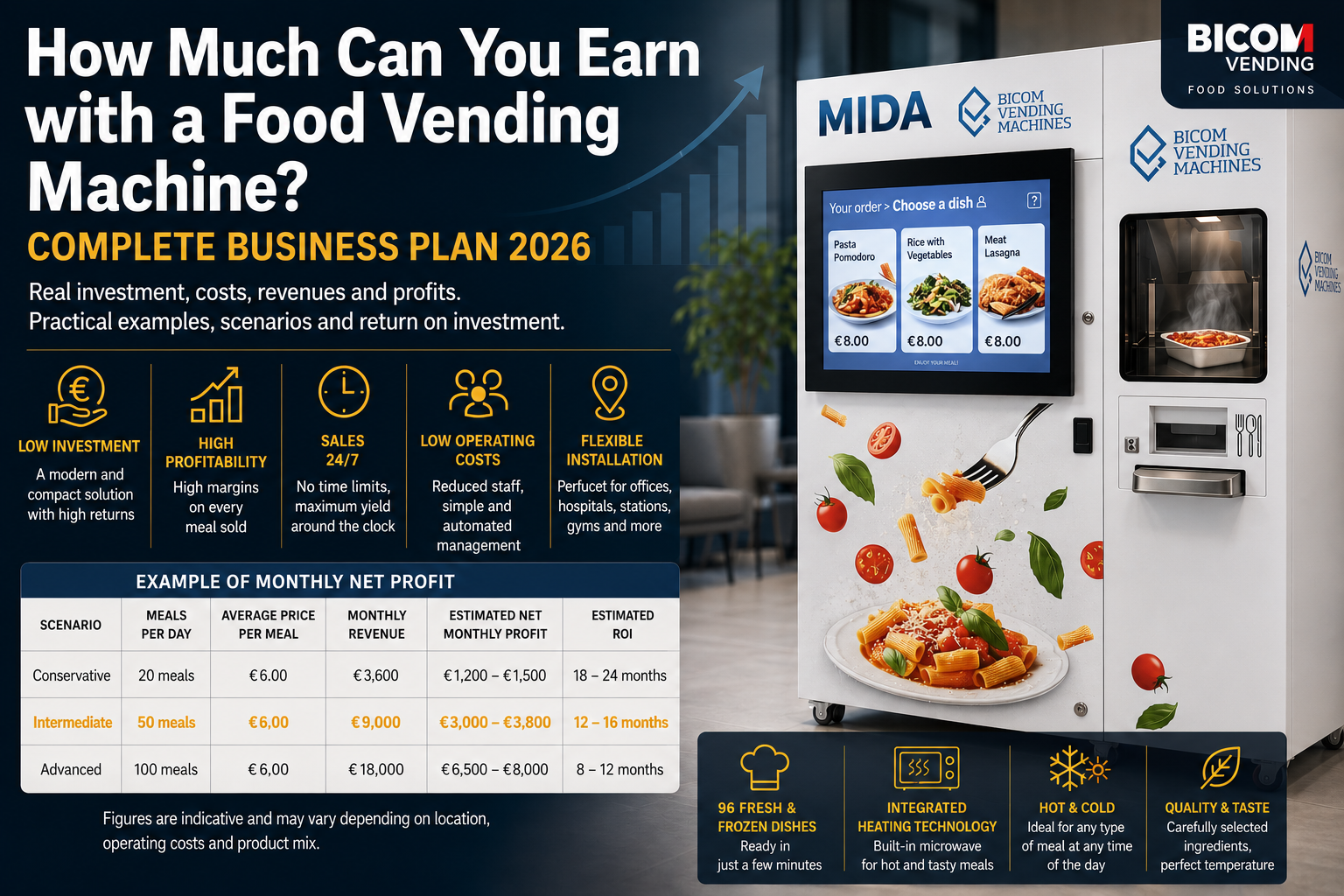
How Much Can You Earn With a Hot Food Vending Machine: Complete 2026 Business Plan
Introduction
The automated vending sector is going through a profound transformation. While a few years ago vending machines were associated almost exclusively with snacks, cold drinks and espresso coffee, today the most economically interesting segment is hot food: ready meals, first courses, soups, hot sandwiches and dishes that can be reheated in seconds. The question is simple but crucial for anyone evaluating this investment in 2026: how much can you really earn with a hot food vending machine? And above all, with what numbers, what costs and what payback times?
In this article we build a complete, realistic and up-to-date business plan for 2026, based on market data, real management costs and profitability scenarios differentiated by location type. The goal is not to sell an easy entrepreneurial dream, but to provide a concrete tool for anyone who wants to seriously evaluate this type of business, whether as supplementary income or as a full-time venture.
The Hot Food Vending Market in 2026
The Italian and European vending market has moved past the stage where the vending machine was seen as a fallback compared to a bar or a company canteen. The growth of hybrid work, the shrinking opening hours of traditional canteens, rising management costs in classic food service, and demand for fast round-the-clock solutions have pushed many companies, hospitals, universities, service stations, airports and hospitality venues to add hot meal vending machines to their offering.
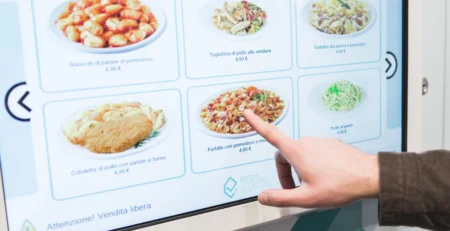
New generations of machines, such as models with regenerating plates or automated industrial microwaves, can serve a hot meal (reaching 70-85°C at the core of the product) in 90 to 180 seconds, guaranteeing certified HACCP hygiene standards and full supply chain traceability. This has made the final product increasingly comparable, in perceived quality, to a fast-food restaurant meal, but with structurally lower management costs than a physical venue with staff.
It’s worth noting that 2026 brings its own specific dynamics: rising energy costs have made the choice of energy-efficient machines even more critical, while growing consumer sensitivity toward food quality (ingredients, freshness, absence of aggressive preservatives) has shifted competition from simple pricing to product quality. Anyone entering this market today no longer competes solely on “the cheapest vending machine,” but on the ability to deliver a meal experience perceived as genuinely good.
How the Business Model Works
Before diving into the numbers, it’s important to clarify the economic structure of this type of business, which is built on three levels:
1. Purchasing or renting the machine. The first decision concerns whether to buy the vending machine outright, finance it through leasing, or opt for an operational rental contract (often called a “free loan” arrangement when paired with a product supplier). Each option has very different implications for initial liquidity, risk and margins over time.
2. Managing the location. The vending machine needs to be placed in a high-traffic spot with an audience genuinely interested in hot meals (workers, students, patients, travelers). The location can be owned (a company space, one’s own premises) or rented/leased, with a fixed fee, a percentage of sales, or both.
3. Restocking and maintenance. Unlike a packaged snack, a hot meal has a shorter shelf life and requires more frequent restocking logistics (generally 2-3 times a week), plus ordinary maintenance (cleaning, sanitizing, temperature checks) and extraordinary maintenance (mechanical breakdowns, component replacement).
The business margin comes from the difference between the price charged to the end consumer (generally between €4.50 and €8.50 for a full meal in 2026, depending on location and product quality) and the sum of: food product cost, machine management costs, location costs and logistics costs.
Startup Costs: How Much Do You Need to Begin
Let’s look in detail at the cost items for launching a single hot food vending point in 2026.
Purchasing the machine
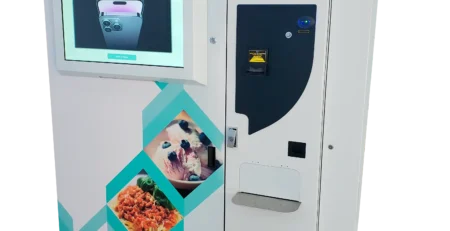
A mid-to-high range hot food vending machine, equipped with a regeneration system (plate or rapid oven), electronic temperature control, multiple payment systems (cash, cards, contactless, app), and storage capacity for 60-150 trays, has a purchase cost in 2026 generally ranging between €9,000 and €18,000, depending on size, number of refrigerated compartments and integrated cooking technology. Simpler machines, geared toward hot sandwiches or baked goods, can cost between €6,000 and €9,000.
Leasing or operational rental
As an alternative to purchase, many operators choose leasing (with a final buyout) or straight rental. A leasing contract over 48-60 months generally involves a monthly payment between €180 and €350, depending on the machine’s value and the applied rate. Operational rental, which often includes maintenance and support, can reach €300-500 per month, but frees up initial capital and reduces the risk of technological obsolescence.
Setup and installation
You also need to factor in transport and installation costs (€500-1,200), any necessary electrical and plumbing work at the location (€300-1,500 depending on the site), and any deposit required by some locations for installation (variable, often equal to one month’s fee).
Initial product stock
An initial stock of ready meals, sized to the machine’s average capacity, requires an investment of roughly €800-1,500, which then repeats at each restocking cycle but with recurring cash flows covered by sales.
Administrative costs and licenses
In Italy, vending operations require opening a VAT number (if not already existing), registering with the Chamber of Commerce as an automated food service activity (ATECO code 47.99.2), complying with HACCP regulations with a related self-monitoring manual, and in some cases a SCIA (Certified Notice of Business Start) filed with the relevant municipality. These administrative startup costs, including consulting and paperwork, run between €500 and €1,500.
Estimated total initial investment (per machine, purchase scenario)
| Item | Estimated Cost (€) |
| Machine (purchase) | 9,000 – 18,000 |
| Transport and installation | 500 – 1,200 |
| Location setup | 300 – 1,500 |
| Initial product stock | 800 – 1,500 |
| Administrative procedures and HACCP | 500 – 1,500 |
| Total | 11,100 – 23,700 |
In a rental/leasing scenario, the initial investment drops drastically to €2,000-5,000 (installation, stock, paperwork), but generates a fixed monthly cost that must be subtracted from the operating margin.
Monthly Management Costs
Once the business is up and running, the recurring costs to consider are as follows.
Food product cost. The production or wholesale purchase cost of a quality ready meal (first course, main course with side dish, or gourmet sandwich) generally falls between €1.80 and €3.20 per portion in 2026, depending on the recipe, the supply chain (fresh, organic or conventional products) and purchase volumes. Those who produce in-house (their own catering operation or a partner kitchen) tend to have better margins than those buying already-packaged products from third-party suppliers.
Electricity. A hot food vending machine, due to its refrigeration and regeneration functions, has higher energy consumption than a simple snack machine. Average consumption ranges between 150 and 300 kWh per month, which at 2026 commercial electricity prices (averaging €0.28-0.35/kWh) translates to a monthly expense of €45-100.
Location fee. This varies enormously: it ranges from locations that don’t require any fee (in exchange for a service perceived as valuable for employees, typical of private companies) to fixed fees of €100-400 per month in high-traffic locations (stations, hospitals, shopping centers), up to percentages of revenue that can reach 10-20% in premium locations.
Logistics and restocking. The cost of restocking (fuel, time, any dedicated staff) for a single point managed personally runs between €100 and €250 per month; for operators with multiple machines, this cost is optimized through structured delivery routes.
Maintenance and support. A preventive maintenance contract, covering periodic checks and minor repairs, costs on average €50-120 per month per machine; on top of this, extraordinary interventions (compressor failures, electronic board issues, payment system malfunctions) should be budgeted for with a further €30-60 per month reserve fund.
Electronic payment system. Commissions on card/contactless payments, now preferred by most consumers, range between 1.3% and 2.2% of transaction volume, plus a fixed POS fee of €15-30 per month.
Insurance and liability. A liability policy covering third-party damages and machine coverage costs on average €20-40 per month.
Summary of monthly costs (owned machine scenario, average location fee)
| Item | Estimated Monthly Cost (€) |
| Electricity | 45 – 100 |
| Location fee | 0 – 300 |
| Logistics/restocking | 100 – 250 |
| Ordinary maintenance + extraordinary reserve | 80 – 180 |
| Electronic payment commissions | 30 – 70 |
| Insurance | 20 – 40 |
| Total fixed/variable monthly costs (excluding product) | 275 – 940 |
The food product cost, by contrast, is directly proportional to the number of meals sold, and must be calculated separately against revenue.
The Revenue Model: How Many Meals Are Sold Per Day
The most decisive variable for the profitability of a hot food vending machine is, unsurprisingly, the number of meals sold per day, which depends almost entirely on the quality of the location.
Based on industry data and real cases monitored over 2024-2026, we can distinguish three scenarios:
Low-traffic locations (small companies under 50 employees, peripheral offices, small hospitality venues): 8-15 meals per day.
Medium-traffic locations (companies with 100-300 employees, mid-sized hospitals, universities with decentralized campuses, secondary service areas): 20-40 meals per day.
High-traffic locations (large production plants with round-the-clock shifts, large hospitals, central railway stations, airports, central university hubs, major highway service areas): 45-90 meals per day, with peaks that in some documented cases exceed 100 meals daily.
Seasonality also needs to be considered: corporate and university locations see significant drops during summer months and holidays, while transit locations (stations, service areas) tend to maintain more stable demand throughout the year, with peaks during vacation periods.
Economic Simulation: Comparing Three Scenarios
Let’s now build three complete monthly simulations, assuming an average selling price of €6.50 per meal (the 2026 average for a quality full meal) and a product cost of €2.50 per portion.
Scenario 1: Low-traffic location (12 meals/day, 26 operating days per month = 312 meals/month)
– Revenue: 312 × €6.50 = €2,028
– Product cost: 312 × €2.50 = €780
– Gross margin on product: €1,248
– Monthly management costs (low tier, no location fee): approximately €300
– Leasing/rental payment (if applicable): €250
– Net monthly operating margin: approximately €700
In this scenario, with a purchased machine (no monthly payment), the margin rises to about €950/month, but the initial investment (€11,000-15,000) payback period extends beyond 12-14 months.
Scenario 2: Medium-traffic location (30 meals/day, 26 days = 780 meals/month)
– Revenue: 780 × €6.50 = €5,070
– Product cost: 780 × €2.50 = €1,950
– Gross margin on product: €3,120
– Monthly management costs (mid tier, fee included): approximately €550
– Leasing/rental payment: €280
– Net monthly operating margin: approximately €2,290
With an initial purchase investment (around €15,000), the payback period falls between 6 and 8 months, a particularly attractive figure for anyone evaluating this business.
Scenario 3: High-traffic location (65 meals/day, 30 operating days including weekends at a round-the-clock site = 1,950 meals/month)
– Revenue: 1,950 × €6.50 = €12,675
– Product cost: 1,950 × €2.50 = €4,875
– Gross margin on product: €7,800
– Monthly management costs (high tier, 10% revenue-based location fee): approximately €1,267 (fee) + €700 (other management costs) = €1,967
– Leasing/rental payment (or depreciation quota if purchased): €300
– Net monthly operating margin: approximately €5,500
In this particularly favorable scenario, the initial investment is typically recovered in 3-4 months, and the business generates an estimated annual net cash flow of between €60,000 and €70,000 per single machine, before taxes.
The Scale Effect: Why Managing Multiple Machines Pays Off
None of the three scenarios described above, taken individually, justifies a full-time business unless we’re talking about scenario 3. The real leap in profitability in the hot food vending sector comes when an operator manages a fleet of machines (typically 5 to 20 units) spread across multiple locations.
This is because many of the fixed costs — time spent on logistics, supplier relationships, administrative management, the maintenance contract — get spread across more units, significantly improving the margin per machine. An operator with 10 machines placed in a mix of medium-to-high traffic locations can realistically generate a combined net operating margin between €15,000 and €30,000 per month, with a restocking route organized into 2-3 weekly runs per geographic area.
This explains why the most common business model in this sector isn’t “a single vending machine as supplementary income,” but rather the progressive build-out of a machine fleet, often starting with 1-2 units to test the market and one’s own operational capacity, then scaling by reinvesting the margins generated.
Critical Success Factors
Location choice is the number one factor. No pricing or product quality strategy can compensate for a location with insufficient traffic. Before signing a contract, it’s essential to analyze the number of people potentially interested (employees, students, patients, travelers), their presence hours, the presence of competing alternatives (bar, canteen, other vending machines), and that specific audience’s willingness to spend on a quality hot meal.
Perceived product quality drives loyalty. In 2026, with increasingly attentive consumers, a product made with recognizable ingredients, adequate portions and convincing taste generates a much higher repurchase rate than a generic product. Many successful operators have built their reputation by partnering with small local producers or gastronomic labs, differentiating themselves from the “industrial” perception typical of traditional vending.
Machine technical reliability directly impacts revenue. A breakdown that takes the vending machine out of service for 2-3 days isn’t just a repair cost, but above all lost revenue and, more importantly, reputational damage among regular users, who may permanently switch to other options. Investing in reliable machines and a fast-response service contract (interventions within 24-48 hours) is often more profitable in the long run than the initial savings on a cheaper machine.
Monitoring sales data allows for assortment optimization. The latest generation of machines offer remote management dashboards, showing in real time which products sell best and at what times, allowing operators to fine-tune restocking and reduce waste (a cost factor that’s often underestimated, since unsold food nearing its expiration date represents a straight loss).
Risks to Consider
An honest business plan must also include the risks. The first is dependence on the location: a contract that isn’t renewed, a company relocation, or simply a change in management at a host facility can result in the loss of an even well-established vending point, wiping out the investments made at that specific site.
The second risk concerns competition: the sector, precisely because of its growing profitability, is attracting new operators, and the most attractive locations (large companies, hospitals, stations) are often awarded through tenders or bids that favor established operators with a solid track record.
The third risk is operational: managing fresh food requires rigor in maintaining the cold chain and respecting expiration dates, with direct liability in case of food safety issues. A single episode of HACCP non-compliance can result in significant penalties and, above all, reputational damage that’s difficult to recover from.
Finally, there’s the risk of technological obsolescence: anyone buying a machine today must consider that the evolution of payment systems, user interfaces and cooking technologies could require an upgrade within 5-7 years to remain competitive.
Tax and Regulatory Aspects in Italy (2026)
From a tax standpoint, vending activity generally falls under the standard business tax regime (sole proprietorship, partnership or corporation depending on the scale of the business), with a 10% VAT rate applied to food service through vending machines (a reduced rate compared to the standard 22%, a notable competitive advantage over traditional food service in some cases).
Electronic transmission of receipts via telematic cash registers integrated into the vending machine’s payment system is mandatory, a requirement that has been fully in effect since 2020 and, by 2026, represents a well-established standard for all operators in the sector.
Those operating multiple machines with significant volumes often consider forming a company (Ltd. or simplified Ltd. under Italian law) for limited liability reasons and tax optimization, while those starting with 1-2 machines often opt for a sole proprietorship under the flat-rate tax regime (if under the €85,000 annual revenue threshold), benefiting from a reduced 15% tax rate (or 5% for the first 5 years if start-up requirements are met) on taxable income.
Building Your Business Plan: Operational Checklist
For anyone who wants to concretely launch this business in 2026, here are the essential steps to follow in sequence:
- Local market analysis: identify at least 5-10 potential locations in your area, assessing their traffic, hours and existing competition.
- Choosing the machine acquisition model: compare at least three quotes across purchase, leasing and operational rental, calculating the break-even point for each option.
- Selecting a product supplier: evaluate whether to produce in-house (requires a licensed kitchen) or rely on a third-party supplier, comparing quality, price and delivery flexibility.
- Negotiating the location contract: define the fee structure (fixed, percentage or mixed), contract duration, termination conditions and responsibility for electrical/water supply.
- Administrative requirements: opening a VAT number, Chamber of Commerce registration, HACCP manual, any required municipal SCIA notice.
- Installation and testing: verify correct operation before opening to the public, test payment systems.
- Monitoring plan: define KPIs to track weekly (meals sold, average ticket, waste, breakdowns) to respond promptly to any deviations from the budgeted plan.
- Scaling plan: define, from the first year onward, a strategy for the second and third machine, capitalizing on the operational experience gained from the first installation.
Marketing Strategies to Increase Sales
Many operators treat the vending machine as a passive installation, forgetting that even a vending point benefits from targeted marketing actions, often at practically no cost.
Signage and visibility. A well-placed sign at the entrance of a facility, or a QR code linking to the day’s menu with photos of the dishes, significantly increases the conversion rate of occasional passersby into regular customers. Communicating “a meal ready in 2 minutes” is particularly effective in the short lunch breaks typical of industrial and hospital environments.
Digital loyalty programs. The most recent payment systems integrate apps or loyalty cards offering discounts after a certain number of purchases (for example, the tenth meal discounted). This mechanism, at nearly zero marginal cost for the operator, measurably increases repurchase frequency.
Menu rotation. Offering a menu that varies throughout the week, with a recognizable dish of the day, reduces the boredom effect typical of traditional vending machines and brings the perceived service closer to that of a well-curated small canteen, rather than a simple food dispenser.
Internal communication with the host company. In corporate locations, involving HR or corporate welfare functions in communicating the service (internal emails, digital notice boards, intranet) drives usage increases that a single operator, on their own, would struggle to achieve.
Feedback collection. A simple feedback collection system (post-purchase QR code, short survey) allows operators to quickly catch any drop in satisfaction with specific recipes, before it translates into an overall sales decline.
Comparison With Other Food Business Models
To put the profitability of hot food vending in context, it’s useful to make a brief comparison with other food-service business models nearby.
A small traditional bar/café typically requires an initial investment of €40,000-80,000 (furnishings, equipment, license, any goodwill payment), employed staff with related labor costs (often the heaviest cost item, between 30% and 40% of revenue), opening hours tied to staff availability, and net margins that, net of rent in the most expensive locations, generally settle between 10% and 15% of revenue.
A food truck involves a similar or higher initial investment (€25,000-60,000 for the equipped vehicle), running costs tied to fuel and travel, the need for continuous presence by the operator, and strong dependence on weather conditions and event seasonality.
A hot food vending machine, by comparison, requires a lower initial investment, doesn’t need dedicated sales staff (the time required is limited to periodic restocking), operates 24 hours a day with no extra costs for evening or night opening, and shows operating margins that, in the favorable cases analyzed above, can exceed 40% of revenue net of product cost. The flip side is less potential for differentiation compared to a staffed service, and a stronger dependence on location, since the vending machine can’t “move” to capture demand the way a food truck can.
Frequently Asked Questions
Do I need a VAT number to start? Yes, automated vending activity qualifies as a business activity in every respect, and requires opening a VAT number with the relevant ATECO code for automated food service, along with registration in the Business Register at the competent Chamber of Commerce.
Is it better to buy or rent the machine? It depends on available liquidity and the project’s time horizon. Buying maximizes the margin over the medium-to-long term but requires more upfront capital and takes on the risk of obsolescence and major breakdowns; renting reduces the initial outlay and often includes support, but compresses the monthly margin and involves a higher overall cost over the long term compared to buying.
How much time does daily management require? For a single machine, the time required generally runs between 3 and 6 hours per week, including restocking, quality checks and minor maintenance. Time increases proportionally less as the number of managed machines grows, thanks to economies of scale in logistics.
Can this be managed part-time, while keeping another job? Yes, this is one of the most common models during the startup phase, especially with 1-2 machines placed near each other, before considering a full-time transition as the machine fleet grows.
What’s a realistic timeline to reach full capacity? A new vending point generally takes 2-3 months to reach its “steady-state” sales volume, a period during which regular customers form gradually through word of mouth and habit.
Conclusion: Is It Worth Investing in 2026?
The numbers tell a clear story: a single hot food vending machine, placed in a medium-to-high traffic location, can generate a net operating margin between €2,000 and €5,500 per month, with an initial investment payback that, in the best cases, happens in under six months. These are competitive figures compared to many other forms of small business, especially considering the low management costs relative to a physical venue with staff.
However, this business’s success isn’t automatic: it depends critically on the quality of the chosen location, the reliability of the machine, the quality of the product offered, and the operator’s ability to rigorously manage logistics, food safety and administrative aspects. Anyone entering this sector with a superficial approach, underestimating the importance of location or food quality, risks ending up with an investment that doesn’t deliver the expected returns.
For those who instead approach the project with a solid business plan, careful location selection and a vision for progressively growing the machine fleet, hot food vending represents, in 2026, one of the most concrete and scalable opportunities in the landscape of small automated food-service entrepreneurship, with growth margins that few other low-staff-intensity sectors can offer.