
How to Start a Food Vending Business: A Complete Guide for New Entrepreneurs
Food vending has quietly evolved from a niche corner of the retail world into one of the most accessible and scalable small-business models available today. What used to mean a rusty machine dispensing chips and soda in a break room has become a genuine alternative to traditional food service — one capable of serving fresh, hot, restaurant-quality meals around the clock, with no staff, no rent for a storefront, and remote management from a smartphone.
If you are considering starting a food vending business, you are entering the market at a good moment. Automation, contactless payments, and changing consumer habits around convenience have combined to make unattended food retail genuinely profitable, not just a curiosity. But like any business, success depends less on the idea and more on the execution: choosing the right niche, the right locations, the right equipment, and building operational discipline around all three.
This guide walks through everything a new entrepreneur needs to know to start a food vending business, from initial market research through to scaling a small fleet of machines — with a particular focus on hot meal vending, one of the fastest-growing and most defensible segments of the industry.
Why Food Vending Is a Compelling Business Opportunity
Before getting into the mechanics of starting a food vending business, it’s worth understanding why the sector is attractive in the first place.
Low overhead compared to traditional food service. A restaurant or café requires a lease, a full kitchen build-out, front-of-house staff, back-of-house staff, and ongoing payroll. A vending operation requires a machine, a location agreement, and periodic restocking. The fixed costs are dramatically lower, and the labor requirement is a fraction of what a brick-and-mortar food business demands.
Scalability. Once you’ve proven a model works in one location, replicating it in a second, third, or tenth location is largely a matter of capital and logistics, not reinvention. You are not training new chefs or building new kitchens each time; you are placing a new unit and stocking it.
24/7 revenue without 24/7 staffing. Traditional food outlets close. Vending machines don’t. A well-placed machine in a factory, hospital, university, or transit hub can generate revenue at 3 a.m. just as easily as at lunchtime, without anyone on the clock.
Growing consumer acceptance of automated food. Contactless payment, touchscreen ordering, and food delivery apps have normalized the idea of interacting with food through a screen rather than a person. Consumers — particularly younger ones — increasingly see a well-designed vending machine as a legitimate, even preferable, alternative to waiting in line.
Data-driven operations. Modern vending machines are connected devices. They report sales in real time, flag low stock, monitor temperature compliance, and allow remote diagnostics. This turns a food vending business into something closer to a technology-managed operation than a traditional retail one, which lowers the burden of day-to-day oversight.
None of this means the business is effortless. Success still depends on choosing the right category of vending, understanding your target customer, and picking equipment that matches your ambitions. That’s where the real planning begins.
Understanding the Different Types of Food Vending
“Food vending” is a broad term, and the category you choose will shape almost every decision that follows — your target locations, your supply chain, your margins, and your equipment needs.
Snack and beverage vending is the traditional model: pre-packaged snacks, candy, bottled drinks, canned beverages. It has the lowest barrier to entry and the simplest logistics, but it also has the thinnest margins and the most competition, since the category is saturated in most developed markets.
Fresh food vending covers sandwiches, salads, and cold prepared items sold refrigerated. Margins are better than snack vending, but shelf life is short, which means frequent restocking and tighter waste management.
Hot meal vending is the segment that has seen the most innovation over the past several years. These machines store complete meals — fresh or frozen — and heat them on demand, typically in under two minutes, delivering a genuinely hot, freshly prepared meal without a kitchen or staff on site. This category commands higher price points than snack or cold vending, serves a real meal occasion rather than an impulse purchase, and is well suited to locations like corporate offices, hospitals, gyms, universities, and transport hubs where people need a proper meal outside typical restaurant hours.
Because hot meal vending occupies the highest-margin, highest-growth part of the market, it’s the segment this guide will focus on most closely — though the planning steps below apply broadly across categories.
Step 1: Research Your Market and Define Your Niche
Every successful vending operation starts with a clear-eyed assessment of demand. Ask yourself:
- Who is the end consumer? Office workers on a lunch break, night-shift factory staff, hospital visitors, gym members, students?
- What are they currently doing for food in the location you’re targeting? If there’s already a good cafeteria nearby, you’re competing with convenience and price. If there’s nothing nearby, you’re filling a genuine gap.
- What price point can that audience sustain? A student population will tolerate a lower price than office workers with an expense account culture.
- What are the operating hours of the site? A 24-hour factory floor has very different needs than a 9-to-5 office building.
This research should also include a survey of potential locations before you commit to any machine purchase. The best food vending businesses are built location-first, equipment-second — not the other way around. Common high-performing site categories for hot meal vending include:
- Corporate offices and business parks without an on-site cafeteria, or with limited cafeteria hours
- Hospitals and clinics, where staff and visitors need food outside standard meal service windows
- Universities and student residences
- Gyms and fitness centers, where demand skews toward higher-protein, portion-controlled meals
- Transport hubs — train stations, airports, motorway service areas
- Factories and logistics centers with shift work that traditional cafeterias can’t easily cover
- Co-working spaces and business incubators
A good rule of thumb: look for locations with consistent footfall and a genuine gap in food access, rather than simply the highest total foot traffic. A train station might have enormous footfall but also several competing food outlets; a mid-sized office park with 400 employees and no cafeteria might be a far better first placement.
Step 2: Build a Realistic Business Plan
Once you’ve identified a promising niche and a shortlist of potential locations, put together a business plan that covers:
Startup costs, including the machine itself, installation, initial inventory, branding, and any renovation the host site requires (electrical upgrades, plumbing for water-connected units, etc.).
Ongoing costs, including food supply, restocking labor, machine maintenance, connectivity fees, insurance, and the commission or rent typically paid to the host location.
Revenue projections, based on realistic estimates of daily transactions and average price per meal — not aspirational best-case numbers. It’s worth building three scenarios: conservative, expected, and optimistic, and planning your cash flow around the conservative case.
Break-even analysis. Because vending machines are a fixed capital investment, understanding how many units you need to sell per day, per week, and per month to cover the machine’s cost and your operating expenses is essential before you sign any location agreement.
Financing. Some vending machine manufacturers and distributors offer financing, leasing, or installment options, which can significantly lower the barrier to placing your first unit without tying up all your working capital in a single asset.
Step 3: Choose the Right Vending Machine
This is the decision that will define the ceiling of your business, and it deserves careful thought rather than a quick purchase based on price alone. The machine is not just a dispenser — it is your kitchen, your storefront, your point of sale, and your brand, all in one unit standing in someone else’s building.
Key factors to weigh:
- Storage capacity and format. How many meals can the machine hold, and in what format (trays, cups, wrapped items)? This determines how often you need to restock and how much variety you can offer at once.
- Temperature control. Can the unit hold food safely at refrigerated and frozen temperatures, and does it comply with food safety regulations in your market?
- Heating method and speed. For hot meal vending, how the machine reheats food — and how long it takes — directly affects the customer experience. A meal that takes five minutes to heat undermines the “convenience” promise that makes vending attractive in the first place.
- User interface. A touchscreen with clear product photography, nutritional information, and a simple purchase flow reduces friction and increases average transaction value.
- Payment systems. Contactless card, mobile wallet, and app-based payment are now baseline expectations, not premium features.
- Remote monitoring and diagnostics. The ability to see sales data, stock levels, and machine health remotely — without a physical visit — is what allows one operator to manage multiple machines efficiently.
- Footprint and installation requirements. Does the machine fit the physical space and power supply at your target location, and what’s involved in getting it installed and running?
- After-sales support. Warranty coverage, spare parts availability, and remote technical assistance all matter enormously once the machine is deployed and generating (or failing to generate) revenue.
This is an area where working with an established, specialized manufacturer rather than a generic supplier makes a real difference. Bicom Vending, an Italian manufacturer based in Bologna with more than two decades of experience in the sector, has built its product line specifically around this segment, and its two flagship machines — Mida and M1 — illustrate the two main approaches an entrepreneur can take when entering hot meal vending.
The Mida: A Full-Scale Automated Canteen
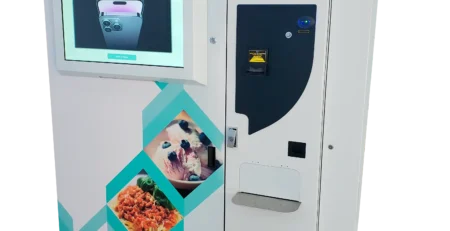
The Mida machine is designed for operators who want to replicate the experience of a full cafeteria in a single automated unit. It is a modular, fully automated system with an integrated oven, capable of storing a large number of ready meals — up to roughly 90 different dishes — at either refrigerated (around +4°C) or frozen (around -18°C) temperatures, depending on the menu and supply chain the operator chooses. Because the oven is built into the machine itself, meals are heated internally and delivered to the customer ready to eat, typically within one to two minutes of ordering, without requiring any external heating equipment or staff intervention.
Mida’s larger capacity and integrated heating make it particularly well suited to higher-traffic sites — factories, hospitals, universities, and large office campuses — where an operator wants to offer real menu variety (multiple dish categories, dietary options, rotating specials) and needs a machine that can sustain high daily transaction volumes without frequent restocking visits. For an entrepreneur planning to build a genuine “vending cafeteria” concept rather than a single-purpose snack point, Mida is the machine built for that ambition.
The M1: A Compact, Low-Cost Entry Point
The M1 machine takes a different approach. It is described by Bicom Vending as a low-cost, hygienically controlled, and complete canteen service, designed specifically for corporate communities and smaller aggregation sites — the kind of location where a full-scale Mida installation would be oversized relative to demand. M1 can hold a smaller range of ready meals, in the region of 30 dishes, in either fresh or frozen states, and unlike Mida, it relies on an external microwave for the final heating step rather than an integrated oven. Customers select their meal from a touchscreen totem, and the machine displays a countdown timer while the food heats, along with promotional or informational content to fill the wait.
This combination of a smaller footprint, lower upfront investment, and simpler heating architecture makes M1 a natural starting point for entrepreneurs testing a new location, entering the hot meal vending business for the first time, or serving smaller sites — a 50-person office, a small gym, a co-working space — where a full Mida installation wouldn’t be justified by the expected transaction volume. Many operators use M1 as a way to prove demand at a new site cheaply before committing to a larger Mida installation once the location’s true potential is established.
Choosing Between Them
In practice, the choice between a machine like Mida and one like M1 comes down to expected volume, available space, and how much menu variety you want to offer at launch. A useful way to think about it: M1 is the machine for validating a location and keeping capital risk low; Mida is the machine for scaling a proven location into a genuine automated canteen. Some operators, in fact, run a portfolio that includes both — placing M1 units in smaller sites and Mida units in flagship high-traffic locations — which is one of the advantages of working with a manufacturer that offers a coherent product range rather than a single fixed model.
Whichever machine you choose, both are manufactured in Italy, come with connectivity built in for remote monitoring and technical assistance, and are backed by manufacturer warranty and spare parts support — details that matter far more once a machine is installed at a client site and generating daily revenue than they do at the purchasing stage.
Step 4: Handle Legal Requirements and Food Safety Compliance
Food vending is a food business, and it is regulated as one. Before placing your first machine, you’ll need to address:
- Business registration and licensing appropriate to your country and region, including any specific food-handling or vending permits required locally.
- Food safety certification, which in most markets requires the operator (or a designated staff member) to hold a recognized food hygiene qualification.
- HACCP compliance (Hazard Analysis and Critical Control Points), the internationally recognized framework for identifying and controlling food safety risks throughout your supply chain, from supplier to machine to consumer.
- Temperature monitoring and traceability, ensuring that every meal can be traced back to its production batch and that storage temperatures are logged and auditable — something well-designed vending machines handle automatically through connected sensors and data logging.
- Insurance, covering product liability, equipment damage, and general business liability at host locations.
- Host site agreements, formal contracts with the property or business hosting your machine, covering placement terms, revenue share or rent, electrical and space provisions, and terms for removal or relocation.
Regulatory requirements vary meaningfully by country, and in some cases by region within a country, so it’s worth consulting a local food safety authority or a lawyer familiar with food retail before finalizing your launch plan — particularly if you intend to operate across multiple jurisdictions.
Step 5: Build Your Supply Chain
Your machine is only as good as what goes inside it. For hot meal vending in particular, sourcing decisions shape both your margins and your customer’s experience.
You generally have two paths:
Partnering with existing meal producers. Many regions have established ready-meal manufacturers who already produce meals suitable for vending — correctly packaged, portion-controlled, and designed for the fresh or frozen storage and reheating conditions your machine requires. This is the fastest way to launch, since it avoids building your own production capability, though it typically comes with tighter margins than producing meals yourself.
Producing your own meals. If you already run a kitchen, catering business, or food production operation — or are willing to build one — supplying your own vending machines directly lets you control quality, cost, and menu development far more closely, and captures the margin that would otherwise go to a third-party supplier. This path requires more upfront investment and regulatory overhead but tends to produce a stronger long-term business, particularly once you’re operating more than a handful of machines.
Whichever path you choose, plan your menu around what actually works well in a reheated, portion-controlled format. Dishes with sauces, grains, and proteins that reheat evenly tend to perform far better than delicate items that degrade in texture when frozen and reheated. Rotating your menu seasonally, and tracking which dishes sell best at which locations, is one of the simplest ways to improve revenue per machine over time — which is exactly the kind of data a connected, remotely monitored machine makes easy to gather.
Step 6: Plan Installation and Logistics
Once you’ve selected your machine, secured a location, and lined up your supply chain, installation logistics come next:
- Confirm the site has adequate power supply and, if required, water and drainage connections.
- Coordinate delivery timing with the host site, particularly for larger installations that may require a loading dock or freight elevator access.
- Plan your restocking route and schedule before the machine goes live, not after. Restocking frequency depends on machine capacity, expected sales volume, and shelf life of the meals you’re stocking — a smaller machine like M1 at a lower-volume site might need restocking two or three times a week, while a high-volume Mida installation at a large site might require daily visits.
- Set up remote monitoring access from day one, so you can track sales and stock levels without needing to visit the machine to find out it’s running low or malfunctioning.
Manufacturers that deliver internationally and provide installation guidance — as Bicom Vending does for both its Mida and M1 lines — can meaningfully shorten this phase, particularly for first-time operators unfamiliar with the practical details of getting a large piece of commercial equipment installed and certified at a client site.
Step 7: Set Up Payments and Technology
Modern vending customers expect a frictionless purchase experience. At minimum, your machine should support:
- Contactless card and mobile wallet payment
- A clear, fast touchscreen ordering interface
- Real-time sales and inventory reporting, accessible remotely
- Remote diagnostics, so technical issues can often be identified — and sometimes resolved — without an on-site visit
This technology layer is what separates a modern food vending business from the coin-operated machines of previous decades. It’s also what allows a single operator to realistically manage a growing fleet of machines across multiple sites, since the alternative — physically checking each machine regularly just to see how it’s performing — doesn’t scale.
Step 8: Market Your Vending Business
Even a well-placed machine benefits from active promotion, particularly in its first weeks at a new location:
- Introduce the machine to the host site’s community through internal communications (many corporate hosts will help promote a new on-site food option to their staff).
- Use the machine’s own screen for promotional content, new menu announcements, and loyalty offers.
- Consider a soft-launch discount or free-sample period to build initial habit and word of mouth.
- Track which products and time slots perform best, and adjust menu and pricing accordingly — this is where the sales data your machine collects becomes a genuine competitive advantage.
Step 9: Manage Operations and Maintenance
Ongoing success depends on operational discipline:
- Restocking on schedule, based on actual sales data rather than guesswork.
- Routine cleaning and hygiene checks, both for regulatory compliance and customer trust.
- Preventive maintenance, catching small mechanical issues before they become machine downtime — every hour a machine is out of service is lost revenue and, if it happens repeatedly, lost trust with the host location.
- Monitoring remote diagnostics, using the connectivity built into modern machines to catch temperature deviations, low stock, or technical faults early.
- Reviewing performance data regularly, to identify underperforming products, pricing opportunities, or locations that may be ready for an upgrade — for instance, moving a site from an M1 to a Mida once demand outgrows the smaller unit’s capacity.
A manufacturer offering a genuine warranty period, spare parts availability, and remote technical assistance — standard with both Mida and M1 from Bicom Vending — meaningfully reduces the operational burden here, since it means maintenance issues don’t automatically translate into extended machine downtime.
Understanding Costs and Return on Investment
While exact figures vary by market, machine type, and location, a realistic cost structure for a hot meal vending business includes:
- The upfront cost of the machine itself, which varies significantly between a compact unit like M1 and a full-scale installation like Mida
- Installation costs, including any site preparation
- Initial inventory and ongoing food supply costs
- Restocking and maintenance labor
- Host site commission or rent
- Connectivity and software fees
- Insurance and licensing costs
Against these costs, revenue is driven by transaction volume and average price per meal. A single well-placed machine, serving a genuine gap in food access at a high-footfall site, can achieve payback within a reasonably short window — though conservative planning should assume a longer timeline, particularly for a first machine while you’re still learning the operational rhythm of the business.
The key financial insight for new operators: your second and third machines will almost always perform better, financially, than your first, because you’ll have already worked out your supply chain, your restocking rhythm, and your site-selection instincts. Budget your first machine as a learning investment as much as a revenue investment, and plan your business case around growing a fleet rather than optimizing a single unit indefinitely.
Scaling from One Machine to a Fleet
Once your first machine is running profitably and reliably, scaling follows a repeatable pattern:
- Document what worked. Which site characteristics, menu items, and price points performed best? Treat your first machine as a case study for the next site-selection decision.
- Standardize your supply chain so it can support multiple machines without a proportional increase in complexity.
- Choose your next machine based on the site, not habit — a smaller, lower-volume location may call for another M1, while a larger site with proven demand may justify investing in a Mida.
- Centralize monitoring. As your fleet grows, the remote data and diagnostics built into modern vending machines become essential rather than optional — they’re what allow one operator, or a small team, to manage ten or twenty machines with the same attentiveness they gave to the first one.
- Negotiate better terms with suppliers and manufacturers as your order volume grows, improving margins across the fleet.
This is where working with a manufacturer that offers a genuinely coherent range — rather than a single fixed model — pays off over the medium term. Being able to match machine type to site size, order additional units from a supplier you already have a working relationship with, and rely on consistent after-sales support across your whole fleet removes a significant amount of operational friction as you scale.
Final Thoughts
Starting a food vending business is not a passive income shortcut, despite how it’s sometimes marketed. It requires genuine market research, careful site selection, real attention to food safety and regulatory compliance, and ongoing operational discipline. But for entrepreneurs willing to put in that groundwork, it offers something increasingly rare in food retail: a business model with low fixed overhead, strong scalability, and a growing base of customers who now see automated food not as a compromise, but as a genuinely convenient option.
The single most consequential decision in this whole process is choosing the right equipment for your first site. A machine that’s oversized for a small location wastes capital; one that’s undersized for a high-traffic site leaves revenue on the table. Manufacturers like Bicom Vending, with a focused product range built specifically around this segment — the compact, low-cost M1 for smaller sites and first-time operators, and the full-scale, high-capacity Mida for high-traffic locations ready for a genuine automated canteen — give new entrepreneurs a practical way to match their first investment to their actual site rather than forcing a one-size-fits-all decision.
Start with the right site, the right machine, and a disciplined operational plan, and food vending can be one of the most efficient food businesses to build from the ground up — one machine, and then one more, at a time.