
Vending vs. Corporate Cafeteria: A Cost-Benefit Analysis for Decision-Makers (Who Don’t Have All Day)
There is a meeting that repeats itself, with minor variations, in almost every mid-to-large Italian company. The HR manager brings employee wellbeing survey data. The CFO brings the budget. The facility manager brings their list of unresolved issues. And at some point, someone inevitably raises the question of lunch.
Corporate lunch is one of those topics that seems trivial until you dive in, only to discover that beneath the surface lies an iceberg of hidden costs, multi-year contracts, dedicated staff, food safety regulations, and — above all — a surprisingly high number of unhappy employees. It’s not trivial. It’s a strategic decision dressed up as a logistics problem.
This article is written for those who need to make that decision, or at least bring the data to the next meeting, without having to read forty pages of consulting reports. We analyze the comparison between a traditional corporate cafeteria and modern hot food vending point by point: costs, flexibility, management, employee satisfaction. With tables, figures, and some commentary we hope will make the reading feel less like a tax manual.
|
An Honest Disclaimer We are a manufacturer of hot food vending machines. This should make you skeptical of our objectivity. And yet we invite you to read on: the figures that follow come from industry research, real company financials, and years of conversations with operators, HR managers, and CFOs. If the data ultimately convinces you, great. If not, at least you have a benchmark for your next conversation with your catering provider. |
1. Setting the Scene: What Are We Actually Talking About
Before diving into the numbers, it’s worth clarifying what we mean by each term, because neither “corporate cafeteria” nor “hot food vending” are monolithic categories.
The Corporate Cafeteria: A Varied Landscape
The corporate cafeteria can mean very different things: an in-house kitchen with dedicated chefs and staff, an outsourced catering service managed by an external operator, a self-service canteen, or even a simple break room where employees eat meals brought from home or bought outside. When we refer to a “corporate cafeteria” going forward, we mean the most common model in Italian SMEs and mid-sized companies: an outsourced catering service with an external manager, a dedicated dining space, fixed lunch hours, and one hot meal per day.
Hot Food Vending: This Isn’t the Break Room Coffee Machine
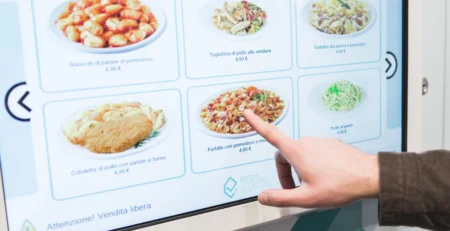
Modern hot food vending has little in common with the hallway coffee machine or the plastic-wrapped sandwiches of the 1990s. We’re talking about next-generation machines that serve complete meals — pasta, main courses, soups, risotto — packaged by certified producers, heated on-board in a matter of minutes, and available 24 hours a day. The right comparison isn’t between “going out for lunch” and “a bag of crisps.” It’s between two corporate food service systems with fundamentally different characteristics, costs, and operational logic.
|
The Italian Market Context According to Confida (the Italian Automatic Vending Association), the Italian vending market has over 800,000 active machines and generates around 2.3 billion euros per year. The hot food segment is the fastest-growing, up 18% over the last three years. It’s no longer a niche. |
2. The Costs: What They Don’t Tell You in the Brochure
Let’s start with the topic that matters most to the CFO sitting at the back of the room. The total cost of a corporate cafeteria is notoriously difficult to calculate — not because the numbers don’t exist, but because they’re spread across different budget lines and are rarely aggregated into a single analysis. Let’s try to do that.
2.1 The Full Cost of a Corporate Cafeteria
An outsourced corporate cafeteria has a cost structure that goes well beyond the per-meal cost billed by the operator. The main line items are:
- Meal cost (employer’s share): In Italy, the average employer contribution ranges from €4.50 to €7.00 per meal, with peaks in major cities and high-quality contracts.
- Rent or depreciation of the dining space: The cafeteria takes up space, and space has a cost. For a 200 sqm room in an industrial building, the opportunity cost ranges from €800 to €3,000 per month depending on location. In urban offices, the figure can be significantly higher.
- Dedicated utilities: Electricity, gas, water, and wastewater disposal for an industrial kitchen. A realistic estimate for a 100-seat cafeteria: €1,500–3,000 per month.
- Administrative management: Contract monitoring, quality checks, complaints handling, meal voucher accounting. This often falls on HR or the facility manager, with an estimated impact of 4–8 hours per month of internal resources.
- Extraordinary maintenance of the premises: Kitchens break down, equipment needs replacing, tiles crack. Even if the contract assigns the operator responsibility for their own equipment, structural costs remain with the company.
- Indirect costs related to the lunch break: Employees coming and going, rigid time windows, reduced productivity in the hours around lunchtime. Difficult to quantify, but real.
|
Cost Item |
Corporate Cafeteria |
Hot Food Vending |
|
Meal cost (employer share) |
€4.50–7.00/meal |
€0–1.00/meal (optional subsidy) |
|
Dedicated space |
150–400 sqm |
1–2 sqm per machine |
|
Monthly utilities |
€1,500–3,000/month |
€60–120/month |
|
Management staff |
1–3 FTE (operator) |
0 internal FTE |
|
Initial structural investment |
€50,000–300,000 |
€0–5,000 (installation) |
|
Minimum contract |
3–5 years (typical) |
1–3 years (flexible) |
|
Routine maintenance |
Operator’s responsibility / shared |
Vending operator’s responsibility |
|
Availability hours |
1–2 hours per day |
24 hours a day, 7 days a week |
Reading the table, a company with 100 employees using 60 meals per day over 220 working days ends up with an annual meal cost (at an average of €5.50) of around €72,600 — before even considering space, utilities, and administrative costs. With hot food vending and zero subsidy, the same service has a direct company cost close to zero. The question is: is the employee willing to pay the full price of the meal? The answer depends on their salary range, the quality of the product, and — above all — how satisfied they were with the cafeteria in the first place.
3. Flexibility: What Does the 6am Shift Worker Eat?
The second major theme of the comparison is flexibility. The traditional corporate cafeteria is a service designed for a world of work that no longer exists: fixed shifts, standard hours, the entire company at lunch between 12:00 and 1:30 PM. This model still works in some contexts, but shows its cracks wherever work organization has become more fluid.
3.1 The Shift Work Problem
In manufacturing, logistics, healthcare, and many service industries, work shifts cover all 24 hours. Night shift workers finish at 6:00 AM. Afternoon shift workers start at 2:00 PM. The cafeteria closes at 2:00 PM. The result is predictable: a significant portion of employees has no access to the service the company is paying for. They either grab a cold sandwich from the vending machine or fend for themselves. Neither option is good for morale.
3.2 The Remote Work and Hybrid Office Problem
Average office attendance in Italian companies with remote work agreements now stands at between 50% and 70% of pre-pandemic levels. This means a cafeteria sized for 100 people is serving an average of 55 per day, with peaks of 80 and days where only 30 show up. The kitchen is running, the staff is present, and fixed costs keep accumulating. Vending, by contrast, adapts naturally to fluctuations: there’s no fixed cost ticking away when the office is half empty.
|
Parameter |
🏛️ Corporate Cafeteria |
🤖 Hot Food Vending |
|
Availability hours |
Typically 11:30 AM–2:00 PM |
24 hours a day, 7 days a week |
|
Night shifts and holidays |
Not covered |
Fully covered |
|
Remote work / variable attendance |
Fixed cost regardless of attendance |
Variable cost tied to actual consumption |
|
Multiple or satellite locations |
Not viable below 50 employees |
Installable anywhere with a power outlet |
|
Menu assortment changes |
Tied to the operator contract |
Flexible, updatable within weeks |
|
Special dietary adaptation |
Limited to the operator’s offering |
Dedicated SKUs (vegan, gluten-free, etc.) |
|
Menu seasonality |
Slow and costly to update |
Fast update with supplier |
|
Scalability during growth |
Requires expanding the premises |
Add a machine within days |
|
The Night Shift Case One of our clients in the metalworking sector, running three 8-hour shifts per day, had a cafeteria operating only for the middle shift. The 70 employees on the other two shifts received a cash meal allowance with associated payroll taxes. After installing two hot food vending machines, the allowance was reduced and night shift satisfaction increased by 34% in the next internal survey. Something tells us that money matters less than you think when a hot meal is actually available. |
4. Management: Who Handles What When Things Go Wrong
Every corporate food service system comes with a management burden. The question is: who carries it? And how heavy is it?
4.1 The Cafeteria: A Contract to Manage, Not a Service That Runs Itself
A contract with a professional cafeteria operator should, in theory, lighten the company’s management load. In practice, the picture is more nuanced. The operator runs the kitchen and manages the staff. But the company still finds itself handling: quality monitoring (complaints come to HR, not the operator), formal complaints management, HACCP compliance verification, attendance tracking and meal counts, coordination for special events or custom menus, and contract renewal and renegotiation every three to five years.
It’s not an unmanageable burden, but it’s a real one. In many SMEs, this falls on someone who already has ten other things to do, and who dedicates to the cafeteria an amount of energy inversely proportional to how much the issue actually deserves.
4.2 Vending: Less Management, But Not Zero
Hot food vending is not a zero-management system. The vending operator handles restocking, machine maintenance, and product rotation. But the burden for the client company is structurally lower:
- No staff to manage: The operator brings their own.
- No premises to maintain: A small area with a power outlet — and a water connection for refrigerated products — is enough.
- Shorter, less binding contracts: Typically 1–3 years, with simpler exit terms than catering contracts.
- Real-time telemetry: Modern machines transmit data on stock levels, sales, and technical faults. The operator steps in before the problem becomes a complaint.
- Simple company interface: One contact, one phone number, one web dashboard. Not a monthly meeting with reports and counter-observations.
|
Parameter |
🏛️ Corporate Cafeteria |
🤖 Hot Food Vending |
|
Internal management staff |
Estimated 4–8 hours/month |
1–2 hours/month (supervision) |
|
Employee complaints management |
Direct, often to HR |
Via the vending operator |
|
HACCP inspections |
Shared between company and operator |
Vending operator’s responsibility |
|
Restocking and product rotation |
Operator’s responsibility (internal kitchen) |
Vending operator’s responsibility |
|
Equipment maintenance |
Shared (premises vs. equipment) |
Fully the operator’s responsibility |
|
Consumption and KPI monitoring |
Monthly report from operator |
Real-time dashboard |
|
Contract management |
Complex, multi-year |
Simplified, shorter |
|
Impact from organizational changes |
High (requires renegotiation) |
Low (scales automatically) |
5. Employee Satisfaction: The Data Nobody Wants to Look At
And here we arrive at the most sensitive chapter. Because you can optimize as much as you like on the cost and management side, but if employees hate the solution, the problem isn’t solved. It’s just moved.
Satisfaction with corporate cafeterias is notoriously low. Not because operators are bad, but for a structural reason: the cafeteria must serve many people with different tastes, dietary constraints, schedules, and expectations, at a price that has to stay affordable. The result is almost inevitably a race-to-the-middle compromise.
5.1 What the Data Says
A 2023 study by Sodexo of over 3,000 Italian workers found that 61% consider their corporate dining service “acceptable but unsatisfying,” and only 23% rate it as “excellent” or “very good.” The main complaints concern menu monotony (48%), ingredient quality (39%), and — perhaps surprisingly — queuing and wasted time (34%).
Hot food vending starts with a psychological advantage: expectations are different. The employee doesn’t expect a restaurant — they expect a quick, hot meal when they need it. When the product quality is good, that expectation is exceeded and the rating is positive. When quality is mediocre, the judgment is just as negative as for the cafeteria, but with the advantage that the operator can change the assortment within days rather than renegotiate a contract.
5.2 The Factors That Actually Matter
|
Parameter |
🏛️ Corporate Cafeteria |
🤖 Hot Food Vending |
|
Menu variety |
Limited to the operator’s dishes |
Wide, quickly updatable |
|
Waiting time |
10–25 minutes (queue + eating) |
3–7 minutes (heating + eating) |
|
Access hours |
Rigid 1.5–2 hour window |
Always available |
|
Perceived quality |
Variable, often disappointing |
Variable, more manageable expectations |
|
Special dietary options |
Rarely adequate |
Dedicated SKUs easily added |
|
Social experience |
High (shared meal with colleagues) |
Low (individual meal) |
|
Freedom of choice |
Limited to the daily menu |
High (I choose what, when, and how much) |
|
Benefit perception |
Often taken for granted |
Appreciated as flexibility |
|
The Variable That Changes Everything The one area where the traditional cafeteria clearly wins is the social dimension of the meal: eating together with colleagues, truly switching off, building informal relationships. If this is a strategic value for the company culture, it’s worth taking into account. Not everything comes down to numbers. But if the cafeteria is empty at 1:15 PM because employees are eating outside or at their desks, that social variable no longer exists anyway. |
6. The Tax Framework: Meal Vouchers and Incentives
An often-overlooked aspect of the comparison is the tax treatment of each solution. In Italy, regulations provide significant tax advantages for corporate food benefits, but with limits and conditions that are worth understanding.
6.1 Corporate Cafeteria e ticket restaurant
A corporate cafeteria run directly or outsourced is fully exempt from taxes and social contributions for the employee, with no cap on the amount, provided the service is delivered on company premises or in accredited facilities. This is the most tax-efficient form of food benefit.
Meal vouchers (paper or electronic), on the other hand, are only tax-exempt up to the limits set by current legislation: €4 for paper vouchers, €8 for electronic ones (thresholds subject to change). Above these limits, the excess value is included in taxable employment income.
6.2 Vending and Tax Benefits
Hot food vending can be integrated into a corporate welfare plan in several ways:
- Direct delivery via welfare platforms: The employee uses welfare credits to purchase meals at the machine. Welfare credits are tax- and contribution-exempt up to the flexible benefit threshold (currently €258.23 per year under standard terms, but extendable through a collective agreement).
- Agreement with electronic meal vouchers: The company issues meal vouchers that the employee uses at the machine. Tax benefit within the applicable limits.
- Direct price subsidy: The company contributes to the meal price through the vending operator. Tax treatment to be verified case by case with a labour consultant.
The reality is that none of the vending solutions reaches the tax efficiency of a traditional cafeteria with full exemption. But when we factor in the savings on fixed costs, the tax gap often narrows — or reverses.
7. The Final Scorecard: A Rating for Each Scenario
Let’s summarize with a scorecard rating both solutions on each criterion analyzed. The scale runs from 1 to 5, where 5 is the highest.
|
Criterion |
Cafeteria |
Vending |
Advantage |
|
Total cost for the company |
★★½ (2,5) |
★★★★☆ (4,0) |
Vending (fixed costs nearly eliminated) |
|
Time flexibility |
★☆☆☆☆ (1,5) |
★★★★★ (5,0) |
Vending (24/7, night shifts) |
|
Scalability with the organization |
★★☆☆☆ (2,0) |
★★★★½ (4,5) |
Vending (just add or remove a machine) |
|
Internal management burden |
★★☆☆☆ (2,0) |
★★★★☆ (4,0) |
Vending (operator manages everything) |
|
Menu variety and updates |
★★☆☆☆ (2,0) |
★★★★☆ (4,0) |
Vending (SKUs quickly updatable) |
|
Social dimension of the meal |
★★★★★ (5,0) |
★★☆☆☆ (2,0) |
Cafeteria (pasto collettivo e convivialità) |
|
Advantage fiscale per l’azienda |
★★★★★ (5,0) |
★★★☆☆ (3,0) |
Cafeteria (esenzione totale) |
|
Employee satisfaction (average) |
★★★☆☆ (3,0) |
★★★☆☆ (3,0) |
Tied (depends on quality) |
|
Solutions for hybrid work |
★☆☆☆☆ (1,0) |
★★★★★ (5,0) |
Vending (no fixed costs running idle) |
|
Implementation speed |
★☆☆☆☆ (1,5) |
★★★★★ (5,0) |
Vending (weeks, not months) |
The aggregate score isn’t the most important thing in this table. What matters is understanding which criteria your company weights most heavily. A company with 300 employees, a strong investment in collective work culture, and a union agreement that includes the cafeteria as a contractual benefit has solid reasons to keep it. A company with 80 people, three daily shifts, a location in a peripheral industrial zone, and a CFO who just saw last year’s catering bill has equally solid reasons to consider alternatives.
8. Quando Ha Senso Scegliere la Cafeteria, e Quando No
Let’s wrap up with some practical guidance, without claiming universal applicability.
The corporate cafeteria makes sense when:
- The company has more than 150–200 employees present simultaneously at the same site, and the numbers justify the fixed costs.
- Working hours are uniform and the shared lunch break has recognized cultural and organizational value.
- A dedicated, fully depreciated space already exists, and the cost of decommissioning it would exceed the benefits of switching.
- The collective agreement includes the cafeteria as a benefit, and removing it would require complex union negotiations.
- The company operates in a sector where meals are part of its identity (hospitality, food industry, etc.) and the shared lunch is a moment of cultural transmission.
Hot food vending makes sense when:
- Work is organized in shifts, hybrid, or with variable attendance.
- The company has multiple locations, including small ones, where a cafeteria wouldn’t be financially viable.
- The available food service budget is limited and the goal is to maximize time coverage at the same cost.
- The company is growing rapidly and needs scalable solutions without structural investment.
- Internal surveys show low satisfaction with the current service and resistance to change — but openness to experimentation.
- The goal is to offer a benefit perceived as modern and flexible, especially to attract younger profiles.
|
The Hybrid Solution More and more companies are adopting a mixed model: keeping a break room with tables and a microwave, reducing or eliminating the internal kitchen, and installing hot food vending as the primary solution. Savings on fixed costs are partly reinvested in product quality or corporate welfare. It’s not the right solution for everyone, but for many Italian companies it’s the most rational point of equilibrium. |
Conclusion: Lunch Is Served — Where, When, and How You Decide
We’ve worked through numbers, tables, scenarios, and a few provocations. The honest conclusion is this: there is no universally correct answer. There is the right answer for your company, right now, with your headcount, your culture, and your budget constraints.
What we hope to have shown is that the comparison must be made with all the data on the table, not just the per-meal cost visible on the invoice. The hidden costs of the traditional cafeteria are real. The tax advantages of the traditional cafeteria are real. The flexibility of modern vending is real. Its social limitations are real.
Those who conduct this analysis seriously, involving the right company functions (HR, Finance, Facility, and — why not — a sample of employees), almost always arrive at a decision that holds up over time and reduces the number of future meetings on the subject of lunch. And that, believe us, is priceless.
|
Want the Numbers for Your Specific Situation? Bicom Vending offers a free cost-benefit simulation based on your company’s real data: number of employees, shifts, average attendance, current service cost. No commitment, no sales pressure. Just numbers. Contact us at bicomvending.com. |