

The Future of Food Vending: Automated Hot Meals, Business Models, and Real Opportunities
For years, vending was associated with packaged snacks, coffee, and last-resort food solutions. Today, that landscape has changed dramatically. Modern food vending—especially systems based on automated hot meals—is redefining the very concept of quick service dining, becoming a concrete answer to real needs for companies, public institutions, hospitals, logistics hubs, and high-traffic environments.
In this article, we explore what food vending is today, how it works, why automated hot food represents a true turning point, which business models are emerging, where this solution actually performs best, and why systems like MIDA and M1 by Bicom Vending embody a new generation of automated foodtech.
What Food Vending Really Means Today
Talking about food vending today means moving beyond the classic idea of the “vending machine.” Modern vending is no longer a product dispenser, but a fully automated food service system designed to deliver complete, safe, high-quality meals on a continuous basis.
The key shift has been the move away from the traditional “snack & beverage” model toward a meal-based offering, including:
-
first courses
-
main dishes
-
single-plate meals
-
healthy options
-
hot comfort food
This evolution has allowed vending to compete with—and in many cases outperform—bars, canteens, and traditional food service in terms of flexibility, cost efficiency, and time coverage.
From Cold Sandwiches to Hot Meals: The Evolution of Vending
The Three Generations of Food Vending
1. Traditional vending
Snacks, drinks, coffee. Low average ticket, impulse consumption, no real experience.
2. Advanced vending
Fresh and refrigerated products, improved design, better interfaces.
3. Automated food vending (today)
Hot meals regenerated on demand, intelligent systems, digital control, and a user experience comparable to a food service outlet.
It is in this third phase that vending truly becomes foodtech.
Why Hot Food Changes Everything
Hot food introduces three decisive factors:
-
Perceived value: a hot dish is seen as a “real meal”
-
Higher average ticket: sustainable and justified
-
Customer loyalty: vending shifts from emergency use to daily habit
The result is a system that does not simply replace the bar, but complements it—or surpasses it where traditional food service cannot operate (night shifts, remote locations, 24/7 environments).
How an Automated Hot Food Vending Machine Works
A hot food vending machine does not “cook” in the traditional sense. It functions like an automated restaurant built around three key phases:
Preparation and Supply Chain
Meals are prepared in certified kitchens following controlled processes, ensuring:
-
high quality standards
-
consistency and scalability
-
food safety
Smart Storage
Meals are stored at controlled temperatures, with continuous monitoring and full traceability.
On-Demand Regeneration
The core of the system is immediate regeneration: the meal is heated and served only when ordered, preserving texture, taste, and safety.
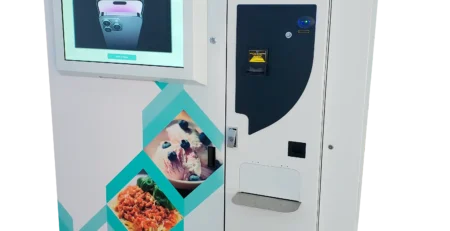
Solutions like MIDA and M1 by Bicom Vending are designed precisely for this purpose: delivering complete hot meals in just a few minutes, without a kitchen, without staff, and in extremely limited spaces.
User Experience: The Real Competitive Advantage
The success of modern food vending depends heavily on user experience:
-
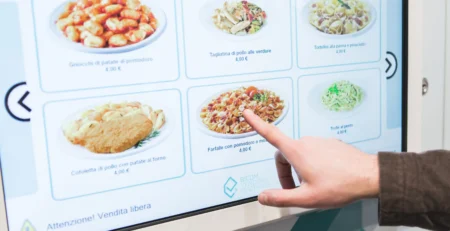
intuitive interfaces
-
predictable service times
-
cashless payments
-
total reliability
A system like M1, compact and modular, proves that today it is possible to serve a hot meal in just one square meter, with an experience fully aligned with modern consumer expectations.
Where Food Vending Really Works
Food vending is not universal—but in certain contexts, it outperforms any other solution.
Companies and Offices
-
replacement or integration of canteens
-
extended service hours
-
corporate welfare solutions
Hospitals and Healthcare Facilities
-
24/7 meals
-
support for staff and visitors
-
hygiene and full control
Logistics Hubs and Industrial Sites
-
night shifts
-
continuous workflows
-
lack of alternatives
Stations, Airports, and Transit Areas
-
fast consumption
-
limited space
-
high turnover
Universities and Campuses
-
autonomy
-
affordable pricing
-
variety
In all these contexts, MIDA is ideal for structured, large-scale projects, while M1 excels in limited spaces or targeted installations.
Food Vending vs Canteens vs Traditional Restaurants
| Aspect | Food Vending | Canteen | Restaurant |
|---|---|---|---|
| Opening hours | 24/7 | Limited | Limited |
| Staff required | None | High | High |
| Space needed | Minimal | Large | Large |
| Scalability | Very high | Low | Medium |
| Costs | Predictable | High | High |
Food vending is not a downsized version of food service—it is a different model, designed for efficiency.
Business Models in Food Vending
Direct operation
The operator controls the entire chain: supply, pricing, and margins.
Revenue sharing
Common in companies and public institutions, with shared revenues.
Food as a Service
Vending becomes a service rather than a product. This is where systems like MIDA reach their full potential.
How Much Can You Really Earn with Food Vending?
Results depend on several variables:
-
location
-
product mix
-
foot traffic
-
operational efficiency
On average:
-
higher ticket values than traditional vending
-
more stable margins
-
predictable ROI
The difference is not made by the machine alone, but by the project behind it.
Sustainability and Food Vending
Modern food vending contributes to:
-
reduced food waste
-
optimized resource usage
-
lower land consumption
-
reduced staffing needs
A compact system like M1 is also a concrete response to urban sustainability challenges.
The Future of Food Vending
Over the next 10 years, we will see:
-
personalization
-
app integration
-
automated corporate welfare
-
vending as urban infrastructure
Food vending will grow faster than traditional food service because it addresses real needs—not trends.
Why Invest in Food Vending Today
Because:
-
traditional food service costs are rising
-
demand for 24/7 meals is increasing
-
companies are seeking flexible solutions
-
the technology is finally mature
Systems like MIDA and M1 by Bicom Vending prove that vending is no longer a second-tier alternative, but a new category within food service.